


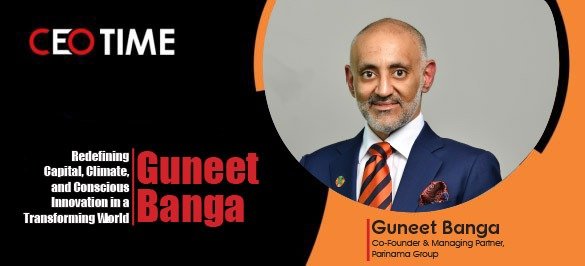
Guneet Banga: Redefining Capital, Climate, and Conscious Innovation in a Transforming World
Co-Founder and Managing Partner, Parinama Group
In an era defined by accelerating climate risk, technological disruption, and shifting global power centers, a new generation of investors is reshaping how capital is deployed and how value is defined. Among them is Guneet Banga, Co-Founder and Managing Partner of Parinama Group, whose work sits at the intersection of climate finance, venture building, and ecosystem building.
Banga represents a growing class of investment leaders who view capital not merely as a tool for financial return, but as a mechanism for shaping long-term planetary and societal outcomes. His perspective is rooted in both analytical rigor and a deeply reflective understanding of how systems evolve particularly in emerging markets where the next phase of global innovation is increasingly being defined.
In this conversation-style executive profile, Banga shares his insights on the shifts redefining industries, the principles guiding his leadership, and the mindset required for the next generation navigating a rapidly changing global economy.
The Three Megashifts Reshaping Global Business
For Banga, the most important transformations underway are not incremental; they are structural.
“The first shift,” he explains, “is the convergence of climate risk and capital markets repricing.”
Across global finance, climate change is no longer a peripheral ESG concern. It is becoming embedded in the core mechanisms of valuation credit, insurance, equity pricing, and sovereign risk. Physical climate risk, once treated as long-term externality, is now being systematically priced into financial models.
“Companies that treat sustainability as compliance rather than strategy are building on sand,” he notes.
The second shift is geographic and geopolitical: the rise of India as a climate innovation epicenter. Far beyond its historical identity as a services economy, India is emerging as a critical proving ground for climate technologies.
With large-scale infrastructure expansion, deep engineering talent pools, and urgent energy transition needs, India represents what Banga describes as a “global laboratory” for scalable climate solutions.
The third shift is philosophical: a transition from shareholder primacy toward stakeholder reality. Long-term value creation increasingly depends on integrating environmental and social externalities into decision-making.
“The firms that internalize this early will lead,” Banga says. “The ones that wait for regulation will always be reactive.”
Culture as a System of Intellectual Discipline
Within the Parinama Group, culture is defined by intellectual discipline as a non-negotiable value.
“The impact space is particularly vulnerable to narrative replacing analysis,” he observes. “Purpose does not exempt you from evidence.”
This commitment extends to structural humility, the recognition that climate systems, capital markets, and emerging economies are too complex for any single actor to fully model.
“We operate in environments where overconfidence is consistently punished,” he says. “The goal is to build organizations where uncertainty is acknowledged, not hidden.”
A third cultural pillar is transparency. In Banga’s view, climate finance and development challenges are too large for siloed solutions.
“No single firm or fund can solve these problems alone,” he explains. “Sharing insight is not optional, it is necessary for system-level progress.”
Building Adaptive Organizations in a Volatile World
Adaptability, for Banga, is not a reactive capability but an organizational design principle.
He describes his approach as “holding the frame loosely” maintaining a clear long-term thesis while remaining flexible in execution.
“In climate finance, assumptions break faster than models can adapt,” he notes. “The key is building systems that constantly update themselves.”
At Parinama Group, this philosophy is operationalized through a multi-division structure spanning venture building, strategic advisory, and ecosystem development.
Each vertical provides a distinct lens on the transition economy:
- Venture building reveals what founders are actually creating
- Advisory work reveals institutional constraints
- Ecosystem engagement reveals policy and societal direction
“Together,” Banga explains, “they create a multi-dimensional intelligence system.”
This architecture has been operationalized through two integrated platforms. ICIITE – the Indian Climate Impact Investing Tech Ecosystem, launched in November 2024 – represents India’s first fully integrated climate innovation and investment ecosystem. It is a centralized impact measurement system which rungs across the platform, reducing due diligence friction and feeding validated data directly into the capital engine.
That capital engine is ICIC – the Indian Climate Investment Collaborative – which convenes family offices, philanthropic capital, and institutional investors around patient, flexible long-term funding structures.
Together, the two platforms are designed to do what no single fund or firm can do alone: create a self-reinforcing flywheel from proven pilots to global capital to recycled deployment that is long-term.
In his view, short-term market pressure creates systemic blind spots, what he calls “the tragedy of the horizon,” where long-term risks are structurally undervalued.
Growth Versus Transformation: A Different Definition of Impact
Banga distinguishes between incremental growth and systemic transformation.
“Most corporate growth optimizes within existing systems,” he explains. “But lasting impact changes the conditions of the system itself.”
This distinction, he argues, is essential in climate and sustainability-focused investing.
A second principle is radical honesty about externalities. Every business model, he notes, carries hidden environmental and social costs.
“The most responsible companies are those that voluntarily integrate those costs before regulation forces them to.”
He also challenges the traditional separation between profit and purpose.
“When properly understood, they reinforce each other,” he says. “Trust of employees, customers, and communities is what creates durable enterprises.”
Technology, Data, and the Reinvention of Climate Finance
Technological advancement is rapidly reshaping climate investing.
The most significant shift, according to Banga, is in measurement infrastructure. Historically, impact investing has struggled with verification measuring whether capital actually produces intended environmental or social outcomes.
Emerging tools such as satellite remote sensing, AI-driven analytics, and improved impact frameworks are changing that equation.
“This is transforming how institutional capital allocates risk,” he explains.
Another major shift is the rapidly improving economics of climate technologies. Solar, wind, battery storage, and green hydrogen have seen faster-than-expected cost declines, fundamentally altering investment assumptions.
What was once considered early-stage innovation is now becoming commercially viable at scale.
Financial digitization, particularly in emerging markets such as India, cannot be ignored. Digital infrastructure is enabling blended finance structures and democratized access to sustainable investment opportunities.
“This opens the door to entirely new capital pathways,” Banga notes.
Defining Moments and the Role of Purpose
Banga’s professional trajectory was shaped by a growing recognition that capital efficiency alone was not enough.
While managing family office investments and early-stage ventures, he experienced a tension between financial success and broader purpose.
“That gap led me to reframe what I was building,” he says.
This reflection ultimately contributed to the formation of Aera VC, followed by Caravel Sustainable Investments, and later the integrated Parinama Group.
“The realization was simple,” he explains. “Purpose is not an add-on. It is a design principle.”
Growing up within the Hong Kong Indian community further shaped his worldview, instilling an early awareness of cultural complexity and civic responsibility.
Priorities for a System Under Transition
Banga identifies blended finance as one of the most underutilized tools in global climate investment.
Private capital alone, he argues, cannot meet the scale of transition financing required especially in emerging economies.
“In India alone, achieving Net Zero requires approximately one trillion dollars annually,” he notes. “That capital cannot come from one source.”
This is precisely the gap ICIC was designed to address. Forty-eight percent of climate funders identify the one-to-ten million dollar Series A band as the most capital –constrained segment in the entire ecosystem, and fewer than three percent of climate-tech start-ups ever reach Series B. Parinama has positioned itself deliberately in that gap as the infrastructure for solving it.
Blended finance combining public, private, and concessional capital is essential to unlocking large-scale infrastructure investment.
He also highlights long-term governance reform as critical. Most corporate governance systems, he argues, remain structurally short-term in orientation.
“The tragedy of the horizon is not just environmental, it is institutional,” he says.
Finally, he emphasizes collaboration.
“Climate change is a collective action problem. The outcome is binary. We solve it together or we all face the consequences.”
The Mindset of the Next Generation
For emerging professionals, Banga emphasizes one core capability: rigorous empathy.
“Analytical rigor without empathy fails in implementation,” he explains. “Empathy without rigor fails in judgment.”
The integration of both, he argues, is essential for addressing complex global challenges.
He also encourages systems thinking over incremental optimization.
“The future will not be shaped by marginal improvements,” he says. “It will be shaped by those who ask how systems themselves must change.”
Above all, he stresses curiosity and adaptability.
“The half-life of skills is shrinking,” he notes. “What endures is the ability to learn, synthesize, and update.”
Conclusion: Capital as a Force for Systemic Change
Guneet Banga’s work reflects a broader transformation underway in global finance, one in which capital is increasingly expected to deliver not only returns, but resilience, sustainability, and long-term systemic value.
His perspective challenges traditional boundaries between investor, innovator, and policymaker. Instead, it proposes a more integrated role: capital as an active participant in shaping future systems.
In a world defined by uncertainty, Banga’s philosophy is clear: the future will belong not to those who predict it most accurately, but to those who build systems capable of adapting to it.
And in that evolution, finance is no longer just a mirror of the world, it is one of the primary forces shaping the future of mankind.