


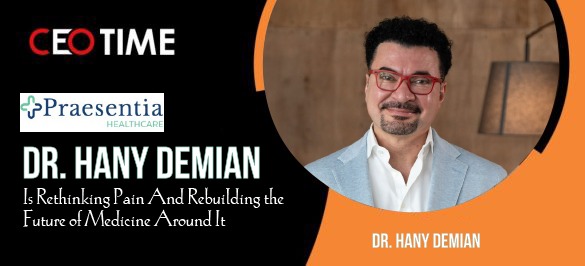
Dr. Hany Demian Is Rethinking Pain And Rebuilding the Future of Medicine Around It
Pain, in its most persistent form, has long existed as one of medicine’s most complicated paradoxes. It is deeply personal yet universally experienced, intensely physical yet profoundly emotional. For millions around the world, chronic pain is not a temporary condition but a quiet, enduring companion one that reshapes lives in ways both visible and invisible.
For decades, the medical system has approached this challenge with a limited toolkit: suppress the symptoms, manage the discomfort, and, when necessary, operate. But what if pain was not something to merely endure or mute? What if it could be understood differently, treated at its source, even reversed?
This is the question that sits at the center of Dr. Hany Demian’s life’s work.
A physician, entrepreneur, and one of the emerging voices in regenerative medicine, Dr. Demian is part of a new generation of healthcare leaders who are challenging long-standing assumptions about how the human body heals. His work does not simply aim to reduce pain; it seeks to reframe the entire conversation around it.
And like many transformative journeys, his did not begin with certainty. It began with disruption.
The Moment That Redirected Everything
Long before he would build healthcare networks spanning continents, Dr. Demian was a young man in Egypt with a very different trajectory in mind. Medicine was not always the plan.
But life, as it often does, intervened.
An unexpected and distressing public incident, one that demanded immediate action placed him in a position where hesitation was not an option. In that moment, stripped of preparation and pretense, he responded instinctively to help those in need. What followed was not just a decision, but a realization.
There are moments that define careers, and then there are moments that define purpose. For Dr. Demian, this was the latter. It revealed something deeper than ambition: a calling rooted in service, urgency, and human connection.
From that point forward, medicine was no longer a profession to consider; it was a responsibility to pursue.
Training in a System Built for Urgency, Not Resolution
After earning his medical degree from Egypt’s Ain Shams University in Cairo, Dr. Demian moved to North America, where he continued his training and began navigating the realities of modern healthcare systems. His early focus included surgical disciplines, particularly in oncology, before transitioning into emergency medicine.
Emergency departments are, by design, places of immediacy. Decisions are made in seconds. Outcomes often hinge on precision under pressure. For a young physician, it is both a proving ground and an education in human vulnerability.
Dr. Demian spent years working in these high-stakes environments, encountering a vast spectrum of cases trauma, acute illness, life-threatening emergencies. But amid the urgency, a pattern began to emerge.
Patients would arrive in distress, receive acute care, and be discharged—only to return again. And again.
The system, he realized, excelled at intervention but struggled with resolution. It could stabilize, but not always restore.
Nowhere was this more evident than in the treatment of chronic pain.
Turning Toward a Neglected Crisis
Chronic pain occupies a peculiar space in medicine. It is widespread, often debilitating, and yet historically underprioritized. Patients frequently find themselves navigating fragmented care, cycling through medications, therapies, and procedures that offer temporary relief but rarely lasting change. For Dr. Demian, this gap was impossible to ignore.
He began to shift his focus first gradually, then decisively toward pain management. It was a field that required not only technical expertise but patience, curiosity, and a willingness to question established norms.
Becoming board-certified in chronic pain management marked a turning point, but it was only the beginning. What followed was a decade of exploration, refinement, and, increasingly, innovation.
He was not interested in maintaining the status quo. He was interested in rethinking it.
A Different Philosophy of Healing
At the core of Dr. Demian’s work is a principle that, while simple in theory, represents a significant departure from conventional practice: the body is not just something to treat it is something to activate.
Traditional approaches to pain often rely on suppression reducing inflammation, blocking nerve signals, or altering perception. While these methods can be effective in the short term, they do not always address the underlying dysfunction.
Regenerative medicine, by contrast, operates on a different premise. It seeks to stimulate the body’s own repair mechanisms, encouraging tissues to heal rather than simply endure.
Dr. Demian became an early and committed advocate of this approach, integrating therapies that were, at the time, still emerging into mainstream awareness. Treatments involving platelet-rich plasma, cellular regeneration, and targeted biological interventions began to shape his clinical philosophy.
But what distinguishes his work is not just the adoption of these therapies it is the precision with which they are applied.
Using advanced imaging techniques such as bedside ultrasound, he is able to guide interventions with remarkable accuracy, ensuring that treatment is not only innovative, but exact.
In this model, medicine becomes less about trial and error, and more about informed, individualized strategy.
Building Systems That Reflect His Vision
Innovation in medicine does not happen in isolation. It requires infrastructure, systems, and, often, an entirely new way of organizing care.
Recognizing this, Dr. Demian stepped beyond the role of clinician and into that of entrepreneur.
In 2014, he founded a network of pain management clinics that would grow to become one of the largest of its kind in Canada. These clinics were designed with a clear intention: to eliminate the fragmentation that so often defines the patient experience.
Instead of navigating multiple providers across different locations, patients could access diagnostics, treatment, and follow-up care within a single, coordinated system.
This integration was not just efficient it was transformative.
It allowed for continuity, collaboration, and a level of personalization that is difficult to achieve in disjointed systems. Each patient’s journey could be understood in its entirety, rather than as a series of disconnected episodes.
As the network expanded, so did the scope of his vision.
The acquisition of a U.S. based spine institute marked a significant step into the American healthcare landscape, bringing his model of care to a new population. Focused on non-surgical and minimally invasive treatments for back pain, the institute reflects the same philosophy that underpins all of his work: intervene intelligently, and only as aggressively as necessary.
Alongside these clinical ventures, he also developed a technology arm centered around diagnostic imaging further reinforcing his belief that precision is foundational to effective treatment.
The Human Element in a Technological Age
In conversations about the future of medicine, technology often takes center stage. Artificial intelligence, advanced imaging, and data-driven diagnostics are reshaping what is possible.
Dr. Demian is no stranger to these advancements. He has consistently embraced tools that enhance accuracy, efficiency, and outcomes.
And yet, he remains equally focused on something less quantifiable: the human experience of care.
Pain, after all, is not just a biological phenomenon. It is influenced by emotion, environment, and perception. Treating it effectively requires more than technical skill it requires understanding.
Patients who walk into his clinics are not viewed as cases to be managed, but as individuals with complex, layered experiences. Their treatment plans reflect not only their physical condition, but their lifestyle, goals, and context.
In an increasingly automated world, this emphasis on human connection is not incidental, it is intentional.
Mentorship and the Multiplication of Impact
While clinical work forms the foundation of his career, Dr. Demian’s influence extends far beyond the patients he treats directly.
As part of his role in academic medicine, he contributes to the training of future physicians, sharing both his expertise and his philosophy. This work ensures that his approach to care does not remain confined to a single practice or geography.
It is, in effect, multiplied.
Through mentorship, he is helping to shape a new generation of practitioners, ones who are more attuned to the possibilities of regenerative medicine, more comfortable with innovation, and more committed to patient-centered care.
In this way, his impact becomes exponential.
Expanding Access, Not Just Innovation
For all the advancements in modern medicine, access remains one of its greatest challenges. Cutting-edge treatments are often limited by cost, geography, or systemic barriers.
Dr. Demian has made it a point to address this imbalance.
Through charitable initiatives associated with his work, he has provided care to patients who might otherwise be unable to afford it. These efforts are not peripheral; they are integral to his philosophy.
Innovation, in his view, is only meaningful if it reaches the people who need it most.
A Future Rewritten
If there is a unifying thread that runs through Dr. Demian’s work, it is the belief that the future of medicine does not have to resemble its past.
He envisions a system that is proactive rather than reactive. One where conditions are addressed early, treatments are tailored precisely, and recovery is measured not just in symptom reduction, but in restored quality of life.
In this future, chronic pain is no longer a life sentence. It is a challenge complex, yes, but solvable.
It is a future where healing is not imposed from the outside, but activated from within.
More Than a Physician
It is tempting to categorize Dr. Hany Demian in familiar terms: doctor, entrepreneur, innovator.
But none of these labels, on their own, fully capture the scope of his work.
He is, perhaps more accurately, a builder of systems. A challenger of assumptions. A practitioner who operates at the intersection of science and possibility. And for the patients whose lives have been reshaped by chronic pain, his work represents something even more fundamental:
The return of control.
The restoration of movement.
The reappearance of hope.
In a field often defined by limitations, Dr. Demian is working to expand what is possible. Not incrementally, but fundamentally.
And in doing so, he is not just treating pain.
He is changing what it means to heal.