


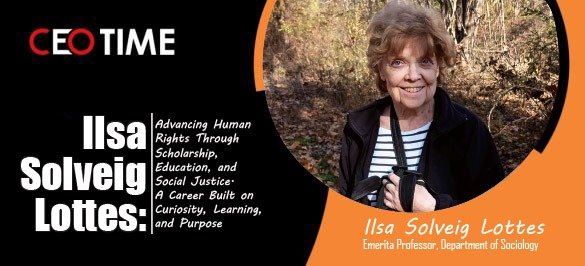
A Career Built on Curiosity, Learning, and Purpose
Some careers follow a carefully designed path from the very beginning. Others evolve through unexpected discoveries, personal convictions, and a willingness to pursue new questions. For Ilsa Solveig Lottes, Emerita Professor in the Department of Sociology at the University of Maryland, Baltimore County (UMBC), her professional journey belongs firmly to the second category.
Her career began in mathematics and secondary education before evolving into sociology, sexuality education, human rights research, public policy, and social justice. What connects these seemingly different disciplines is a lifelong commitment to learning and a desire to use knowledge to better understand, and ultimately improve, the world around her.
Lottes grew up during a period when women’s career choices were often narrowly defined. Many women were expected to become secretaries, teachers, nurses, waitresses, or salespeople, while the expectation of becoming a housewife and mother remained common.
She had no grand career plan.
Yet an excellent high-school mathematics teacher changed the direction of her life. The teacher was strict and demanding, but provided Lottes with a strong foundation in mathematics. She discovered that she had both an aptitude for the subject and an enthusiasm for learning.
At Purdue University, she excelled academically, graduating first in the School of Science with highest distinction in mathematics. She immediately continued her education, earning an M.S. in mathematics before beginning a career teaching mathematics at the secondary level in Indiana and Pennsylvania.
As a teacher, she developed new curricula and instructional materials for students. It was a meaningful beginning, but after approximately 15 years, she began to feel that something was missing.
She was no longer learning enough.
The mathematics courses she taught changed relatively little from year to year, and Lottes’ natural curiosity demanded continued intellectual growth. At the same time, her involvement in social justice issues was becoming increasingly important to her.
These two forces, learning and justice, would eventually redirect her entire career.
From Mathematics to Sociology
Lottes became increasingly active in addressing social issues, participating in protests and community education around concerns including the Vietnam War, racial discrimination, discrimination based on sexual orientation and gender identity, gun violence, and unequal access to healthcare.
She marched, educated people door to door, wrote to elected officials, and encouraged others to sign petitions.
The more she learned about social inequalities, the more convinced she became that she needed additional education to understand these issues more deeply and to find a professional path that would allow her to continue addressing them.
That decision led her to graduate school at the University of Pennsylvania.
There, she explored two areas of study: quantitative research methods and sexuality education. Ultimately, she chose the more practical quantitative research path for her degree, specializing in Measurement and Evaluation Techniques in Experimental Research.
Her dissertation and presentation received meritorious ratings in 1986.
Her mathematical background, combined with her new expertise in research methodology, created an unusual academic foundation. In 1987, she joined the Department of Sociology at UMBC, where she taught sociology and public policy to undergraduate and graduate students, including required courses in research methods and statistics.
But her academic transformation did not stop there.
The Chair of the Sociology Department encouraged her to develop courses related to sexuality. Lottes embraced the opportunity and created courses including Sexuality in Sociological Perspective and Sexuality in Cross-Cultural Perspective.
These courses gave her a platform to examine subjects she considered socially important, including sexuality education, sexual health services, sexual coercion, and discrimination against sexual and gender minorities.
For Lottes, teaching was again becoming a process of discovery.
The difference was that she was no longer simply teaching established material. She was continually learning, researching, developing courses, and exploring complex social questions.
A Scholar Who Refused to Stop Learning
Adaptability became one of the defining characteristics of Lottes’ academic career.
As a professor, she had opportunities to attend professional conferences, often attending two conferences a year and making a deliberate effort to participate in as many sessions as possible.
She became involved with professional organizations including the Society for the Scientific Study of Sexuality, the International Academy of Sex Research, the World Association of Sexology, now the World Association for Sexual Health, and the American Sociological Association.
Over the course of her career, she delivered more than 90 invited or referred presentations.
For Lottes, conferences were more than professional obligations. They were opportunities to challenge assumptions, exchange ideas, encounter new research, and understand how scholars and professionals in different parts of the world approached similar problems.
This international perspective became increasingly important to her.
In the mid-1990s, she studied the programs of action emerging from two major international conferences: the International Conference on Population and Development in Cairo and the Fourth World Conference on Women in Beijing.
These international discussions introduced her more deeply to the concept of sexual rights, including rights related to sexuality education, sexual health services, and personal choice in intimate relationships.
Her interest in sexual rights soon expanded.
She began asking a broader question: if sexual rights are human rights, what does that tell us about human rights more generally?
That question eventually led her beyond sexuality and toward issues including food, shelter, dignity, respect, and quality of life.
The evolution of her scholarship reflected a natural progression, from examining specific rights to exploring the broader conditions required for people to live healthy, dignified lives.
This work contributed to her books on Quality of Life and Human Rights Policies in the U.S.
The Power of International Collaboration
International collaboration played an especially important role in Lottes’ intellectual development.
She believes that people can easily become limited by the perspectives and assumptions of their own countries. Working internationally offered her opportunities to encounter different cultural experiences and challenge her own assumptions.
One memorable experience took place during an international conference in Cuba, where she met Mariela Castro Espín, she is the niece of the former ruler of Cuba, Fidel Castro, who was involved in sex education and advocacy concerning sexual and gender minorities.
Although plans for a subsequent writing project about Cuba were not ultimately realized, Lottes’ time in Havana allowed her to learn about the culture and interact with members of communities supported by Castro Espín’s work.
The experience reinforced the value of seeing social issues through perspectives beyond one’s own national context.
Her most significant international academic collaboration, however, took place in Finland.
Lottes spent three years of her sabbaticals working in the Department of Sociology at the University of Helsinki. There, she collaborated with Finnish researcher Osmo Kontula of the Family Federation of Finland.
Together, they edited New Views of Sexual Health, The Case of Finland, published in 2000. Lottes contributed four chapters to the book, which examined different dimensions of sexuality and the relationship between sexual rights and sexual health in Finland.
The collaboration produced not only scholarship but also remarkable professional experiences.
In 2000, Lottes and Kontula, along with other contributors, were invited to meet Finnish President Tarja Halonen.
She later received a Fulbright Specialist Award to work in the Department of Health and Social Care at the Applied University of Jyväskylä.
These experiences strengthened her belief that international scholarship is essential to understanding social questions.
Research That Connects Rights and Well-Being
Among the publications Lottes is especially proud of is her substantial article in the Journal of Sex Research, titled “Sexual Rights: Meanings, Controversies, and Sexual Health Promotion.”
Another important publication, co-authored with Finnish colleague Tapani Alkula, examined patterns of sexual attitudes across 32 European countries using data from the European Values Survey and cluster analysis. The study was published in Sexuality Research and Social Policy.
Together, these works demonstrate the evolution of her research, from quantitative methods and sexuality studies toward broader questions concerning rights, health, social policy, and quality of life.
Her mathematical training remained valuable throughout this transition.
Rather than abandoning her original discipline, Lottes carried its analytical principles into sociology. Research methods and statistics became tools through which she could investigate questions that mattered deeply to her.
The result was an interdisciplinary career in which mathematics, sociology, sexuality, health, public policy, and human rights informed one another.
Teaching as an Opportunity to Empower Others
For Lottes, education has never been simply about transferring information from professor to student.
She viewed the classroom as an environment where students could develop their own questions, challenge assumptions, and discover issues that might shape their future work.
Many of her students pursued research projects connected to social justice, either under her guidance or through master’s and doctoral dissertations.
She also collaborated with undergraduate students on publications and research projects, learning from their experiences and perspectives.
At undergraduate research events, she supported students examining issues involving immigrants, sexual and gender minorities, prisoners, and women in different countries.
Her office hours often became conversations about social problems rather than simply discussions about course material.
Students who had personally experienced stigma were particularly drawn to the subjects she taught.
As her academic interests evolved, she developed additional courses such as Sexuality, Health and Human Rights and Health and Human Rights.
These courses reflected the central theme of her career: understanding how social structures and policies affect people’s ability to live with dignity and exercise their rights.
Leadership Rooted in Human Rights
Lottes’ understanding of leadership is closely connected to her views on human rights.
She believes leaders have a responsibility to respect others, treat people equitably, and contribute to the communities around them.
During her academic career, her responsibilities extended beyond teaching and research. She served the university through roles including membership in the University Faculty Senate and faculty advising for residence halls.
As Chair of the Women’s Commission, she was able to provide a small grant supporting an organization working to create employment opportunities for women in economically disadvantaged areas of Latin America.
Her commitment to service continued after retirement.
She volunteered as a mathematics tutor, spending two hours each week helping seventh- and eighth-grade boys in an economically disadvantaged area of Baltimore.
The experience reinforced one of her long-held beliefs: many young people can succeed when they are given appropriate support, patience, and time.
For Lottes, leadership therefore involves more than authority or recognition.
It means giving back.
Learning from Mistakes
Even a career built around education and research includes moments of reflection.
Lottes openly acknowledges one regret from the later part of her teaching career: she struggled to motivate some students to attend lectures and complete assigned reading.
Because she had been a highly committed student herself, she initially expected others to approach education in a similar way.
She eventually recognized that such expectations were unrealistic.
Students have different circumstances. Many work part-time jobs, support families, or face responsibilities that make attendance difficult. She also encountered concerns involving plagiarism and cheating.
Her experience taught her a valuable leadership lesson: never assume that other people will approach responsibilities in exactly the same way you would.
Had she been able to teach those courses again, she says she would have placed greater emphasis on attendance and incorporated more checks to encourage students to engage with assigned materials.
The lesson reflects a broader principle that has remained important throughout her career, understanding people requires avoiding assumptions.
Balancing Scholarship, Service, and Life
Academic life demands the ability to manage multiple responsibilities.
Lottes’ formal academic year generally ran from late August through late May, leaving summers without paid teaching responsibilities. She used much of that time for research and writing.
The structure allowed her to concentrate on teaching and service during the academic year and reserve the summer months for scholarship.
Yet professional dedication came with personal costs.
Lottes acknowledges that she did not always manage her personal life as successfully as she would have liked. Her marriage eventually ended, and she connects part of that experience to the strength of her convictions around human rights.
There are issues on which she has found it difficult to compromise.
For Lottes, questions involving access to healthcare, child hunger, immigration policies affecting families, and basic human dignity are not abstract political debates. They are questions of human well-being and rights.
Her willingness to maintain strong convictions has been an important part of her identity as a scholar and advocate.
Looking Beyond Retirement
Retirement has not ended Lottes’ intellectual engagement.
Her future work will continue to examine how government policies affect the well-being of citizens. She remains interested in understanding which policies improve people’s lives, which fail to do so, and how communities can work collectively to address violations of rights.
Her message is straightforward: people should care, remain responsible, understand human rights, and participate in improving their communities.
This continuing commitment illustrates that scholarship does not necessarily end when a formal academic position does.
For Lottes, learning remains a lifelong activity.
A Legacy of Kindness, Empathy, and Responsibility
When Lottes considers her legacy, she does not focus primarily on academic titles or publications.
She hopes people will become kinder, more empathetic, and more aware of the importance of human rights.
She views human rights as closely connected to basic human needs. Food, shelter, healthcare, dignity, and respect are not luxuries, but fundamental aspects of a decent life.
She also believes the business community has an important role to play.
Businesses influence employees, families, communities, and wider society. Lottes encourages business leaders to consider not only financial performance but also the well-being of the people who make that performance possible.
She is particularly concerned about extreme economic inequality and believes businesses should find ways to provide greater support to employees and communities.
One idea she advocates is the creation of reward systems that recognize companies making meaningful contributions to the well-being of their workers and communities.
Her broader philosophy is captured by a quotation from Franklin D. Roosevelt that she recommends to those seeking a more just society: “The test of progress is not whether we add more to the abundance of those who have much. It is whether we provide enough for those who have little.”
That principle encapsulates much of Lottes’ professional and personal journey.
From mathematics to sociology, from teaching to research, from sexuality studies to human rights, and from university service to community volunteering, her career has consistently been driven by a desire to understand the world and make it better.
A Life Defined by Learning and Service
Ilsa Solveig Lottes’ career demonstrates the extraordinary possibilities that emerge when intellectual curiosity is combined with social purpose.
She began as a mathematics student who excelled in a discipline that shaped her analytical abilities. She became a teacher, then a sociologist, researcher, sexuality educator, international scholar, author, mentor, and advocate for human rights.
At every stage, she followed the same fundamental instincts: learn more, question assumptions, educate others, and contribute to the community.
Her journey also demonstrates that professional reinvention does not require abandoning one’s past. Instead, previous experiences can become the foundation for entirely new areas of expertise.
The mathematics she mastered as a student ultimately strengthened her research. Teaching prepared her to communicate complex ideas. Social activism gave her a sense of purpose. International collaboration broadened her perspective. And her academic career provided a platform from which she could influence students, colleagues, communities, and wider conversations about rights and well-being.
Now, as an Emerita Professor, Lottes continues to look ahead.
Her work remains centered on a simple but powerful question: how can societies create conditions in which more people are able to live with dignity, opportunity, and respect?
Her answer has never been limited to one discipline.
It lies in education, research, empathy, responsible leadership, community action, and a willingness to recognize the humanity of others.
That may ultimately be the most enduring lesson of her career: meaningful change begins when people choose not only to learn about the problems around them, but also to care enough to do something about them.