


The most transformative elements of a modern building are often the ones that remain unseen.
Behind the polished facade of a luxury residence, the seamless experience of a five-star hotel, the scale of an iconic stadium, or the sophistication of a landmark commercial tower lies an intricate ecosystem of technology and infrastructure. Security systems, connectivity networks, electrical systems, automation, data cabling, access control, and intelligent technologies work quietly in the background, shaping how people experience and interact with the built environment.
As buildings become increasingly connected, intelligent, and electrified, the companies responsible for this underlying infrastructure are assuming a more consequential role.
VIP Systems, Inc. stands at that intersection.
What has evolved beyond the conventional boundaries of a low-voltage solutions provider is now a broader infrastructure enterprise encompassing low-voltage systems, electrical contracting, security, connectivity, automation, and electrification.
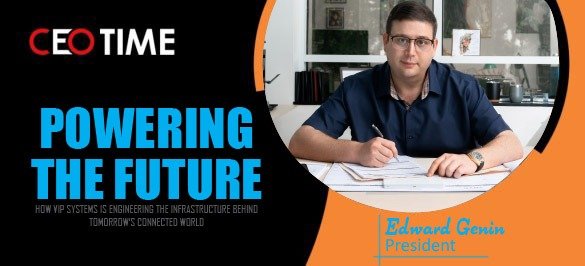
For Edward Genin, the company’s vision is encapsulated in a simple yet forward-looking philosophy: “Powering the future with VIP Systems.”
It is more than a prospective tagline. It represents the direction in which the company is building its next chapter — a chapter shaped by intelligent buildings, luxury developments, electrification, artificial intelligence, data centers, and the rapidly changing expectations of modern infrastructure.
BEYOND LOW VOLTAGE: THE HIGH-VOLTAGE EVOLUTION
The infrastructure of a modern development can no longer be divided neatly into isolated categories.
Electrical systems support digital technologies. Networks enable intelligent devices. Security systems rely on connectivity. Automation brings multiple building functions together.
Meanwhile, the rise of artificial intelligence is creating an entirely new scale of demand for both digital infrastructure and electrical power.
VIP Systems has been expanding alongside the convergence.
Genin makes the company’s broader positioning clear: “VIP Systems is not just a low voltage solutions provider, but we’re also an electrical contractor.”
The distinction is important.
The company’s capabilities have expanded into electrical contracting and complex power-related work, including medium- and high-voltage projects, allowing VIP Systems to participate in projects that extend beyond traditional low-voltage disciplines.
Artificial intelligence and data centers accelerate demand for sophisticated infrastructure, and the relationship between electrical capacity and digital connectivity is becoming increasingly important. VIP Systems is positioning itself to address both.
Its traditional expertise in access control, CCTV, networking, and Internet of Things technologies is now being complemented by electrical capabilities that can support the infrastructure requirements of increasingly complex environments. The result is a company whose scope reflects the interconnected nature of the modern built environment.
POWERING ULTRA-LUXURY & BRANDED RESIDENCES
Nowhere is this convergence more apparent than in the luxury residential and hospitality sector.
Today’s luxury development is expected to deliver more than architectural beauty. Residents and guests increasingly expect seamless connectivity, intelligent controls, sophisticated security, automation, and technology that enhances convenience without compromising the character of the property.
VIP Systems has been working closely with developers pursuing this vision, participating in projects associated with some of the world’s most recognizable luxury hospitality and residential brands.
Genin points to projects involving Ritz-Carlton, St. Regis, Rosewood, The Standard, and Kempinski, among others.
The company is currently involved with a Kempinski development in Miami’s Design District, while other projects include Okan Tower, a Hilton-branded residence in downtown Miami.
These projects demonstrate the breadth of VIP Systems’ involvement in contemporary luxury developments. Technology is not simply added to the building after its architectural vision has been established. It becomes part of the development’s functionality from the outset.
Within luxury residences and condominiums, VIP Systems’ work encompasses low-voltage access control, CCTV, Internet of Things solutions, and automation. The objective is to create environments where technology operates naturally within everyday life.
The resident may simply experience a secure entrance, an intelligently controlled environment, reliable connectivity, or an automated feature. Behind that experience, however, are layers of infrastructure requiring careful planning, integration, installation, and service. That invisible architecture is where VIP Systems operates.
WHERE TECHNOLOGY MEETS HOSPITALITY
One of the company’s current projects particularly illustrates how diverse these responsibilities have become. At E11EVEN Hotel & Residences, a new five-star luxury development by PMG and E11EVEN Partners, VIP Systems is undertaking a broad range of scopes.
Genin describes involvement ranging from “low voltage access control” to electrified motorized window shades, lighting control, and do-not-disturb systems.
The role extends even further into hospitality operations. VIP Systems is involved in hospitality consulting and in ensuring that the necessary equipment and software are available for the hospitality team to operate the property effectively.
This represents a significant shift in how infrastructure companies contribute to large-scale developments. Rather than being confined to a single technical installation, VIP Systems is participating in the broader technological ecosystem of the property.
A luxury building may have extraordinary architecture, premium materials, and world-class hospitality, but the experience ultimately depends on thousands of operational details working together. Technology has become one of those details — and often one of the most important.
A PORTFOLIO EMBEDDED IN MIAMI’S GROWTH
VIP Systems’ story is closely intertwined with the evolution of South Florida’s built environment. Over the years, the company has participated in projects that have become recognizable components of Miami’s architectural and commercial landscape. Its portfolio includes CCTV installation at Hard Rock Stadium and the Miami Marlins’ stadium, as well as low-voltage solutions at Brickell City Center, one of Miami’s major mixed-use developments.
The company has also provided infrastructure solutions to Miami Worldcenter, another significant development campus. Genin describes these as some of the “iconic projects that VIP has been a part of.”
The significance of such projects lies not simply in their visibility, but in what they represent. A stadium may be recognized for its architecture, sporting events, and atmosphere. A mixed-use development may be known for its retail, residences, offices, and public spaces. A luxury tower may become a defining element of a city’s skyline. For VIP Systems, participating in these environments has meant contributing to the technological foundation upon which major developments operate.
INFRASTRUCTURE FOR THE AI ERA
The next phase of the company’s journey may take that expertise into an entirely different class of infrastructure. Artificial intelligence is transforming the global technology landscape, and with it comes rapidly increasing demand for data centers capable of processing, storing, and transferring extraordinary volumes of information.
Genin sees this as one of the company’s most significant future opportunities. “Our next step in growing the company will be AI data centers and their electrification,” he explains.
The opportunity is particularly aligned with VIP Systems’ evolving capabilities. Data centers require extensive fiber optics and data cabling to facilitate communication and the movement of information throughout their facilities. At the same time, their energy requirements make electrical infrastructure a critical component of their operation. This creates a natural convergence between the company’s low-voltage and electrical disciplines.
VIP Systems is therefore looking not only at traditional connectivity-related scopes within data centers but also at electrification and other specialized opportunities within these environments.
For the company, the AI revolution is consequently not simply a technology trend. It is an infrastructure opportunity. As computing becomes more powerful and artificial intelligence becomes embedded across industries, the physical environments supporting these technologies will become strategic assets in their own right.
The future of AI depends not only on algorithms and software, but also on the buildings, electrical systems, connectivity infrastructure, and networks capable of supporting them. VIP Systems intends to participate in that physical foundation.
LEADING THE NORTH AMERICAN EV TRANSITION
The company’s forward-looking strategy extends beyond AI. Electric mobility is creating another rapidly expanding infrastructure market, particularly as residential developments, commercial properties, hospitality environments, and fleet operators increasingly accommodate electric vehicles. Through its work with VoltiE Group, VIP Systems has expanded into EV-charging sales and installations.
Genin views the opportunity as part of a broader movement toward e-mobility across North America and beyond. “This is becoming a standard, and VIP is definitely at the front line of this in the offering, installation, and service capabilities,” he says.
The significance of EV charging is particularly evident within the luxury-development sector. For a branded residence, charging infrastructure can become another amenity offered to residents. For commercial properties, it can support employees, visitors, customers, or fleets transitioning to electric vehicles.
VIP Systems is also examining opportunities in the Caribbean, where e-mobility is being integrated into luxury residential, high-rise, and enterprise environments.
PARTNERSHIPS THAT EXPAND POSSIBILITIES
Entering emerging infrastructure markets requires more than technical ambition. It requires partnerships capable of bringing together complementary expertise. VIP Systems’ collaboration with VoltiE Group provides one such avenue within EV charging.
Genin describes the relationship with VoltiE Group as a highly positive experience, emphasizing the integration of the teams and the robustness of the combined offering.
This collaborative approach reflects an important characteristic of modern infrastructure. No single company necessarily possesses every capability required by increasingly complex projects. Successful execution often depends on integrating specialized technologies, expertise, software, equipment, and service capabilities into one coherent solution. For VIP Systems, partnerships therefore become an extension of its own capabilities.
GROWTH ACROSS NORTH AMERICA
The company’s ambitions are also geographic. VIP Systems has expanded its regional operations across the East Coast, Central region — including its Texas office — and the West Coast through California.
Genin describes the company’s current growth as significant and expresses enthusiasm about the expansion of its teams across these regions. “We have a huge growth right now, and we’re super excited to be powering the future.” This statement by Genin captures the company’s present moment.
VIP Systems is no longer defined by a single geographic market or a single technical discipline. Its projects now extend across regions, while its service portfolio continues to broaden. Its work with major developers — including Kushner Companies, PMG, Related Companies, and Dinnerstein Companies — further demonstrates the scale and diversity of the environments in which the company operates.
From luxury residences to mixed-use developments, from hospitality environments to future AI infrastructure, the company’s trajectory is increasingly tied to the evolution of the environment itself.
THE HUMAN SIDE OF INFRASTRUCTURE
For all the sophistication of the technologies involved, infrastructure ultimately remains a people-driven business. Systems must be designed by people, installed by people, integrated by people, and serviced by people.
This creates an often-overlooked challenge within specialized infrastructure industries: the need to continuously develop and educate the people responsible for keeping these systems functioning. For Genin, education forms part of the legacy he wants VIP Systems to leave behind. He points to the need to continue educating the industry and its associates while ensuring that installations are completed within the required timeframes and service standards expected by customers.
It is a perspective that places technical knowledge and customer service alongside innovation. Technology may provide the tools, but expertise determines how effectively these tools are deployed.
A LEGACY OF SOLUTIONS AND SERVICE
When asked about the legacy he wants VIP Systems to create, Genin does not define it solely through revenue, geographic expansion, or the number of projects completed.
Instead, he returns to the company’s fundamental purpose. “We’re always empowering our customers with the right solutions, and we’re always there to service our customers.”
That philosophy provides a useful lens through which to understand VIP Systems’ evolution. The company is expanding into new technologies, new markets, and new infrastructure disciplines, but the underlying objective remains consistent: provide solutions that address customers’ requirements and support those solutions through dependable service.
In an industry characterized by constant technological change, that continuity matters. A building may adopt new systems. A development may incorporate new technologies. A data center may require new levels of connectivity and electrical capacity. A luxury residence may introduce new forms of automation. EV charging standards may continue to evolve. Yet customers will continue to expect the same fundamentals — competence, reliability, responsiveness, and service.
ENGINEERING TOMORROW’S CONNECTED WORLD
The transformation taking place within VIP Systems mirrors a much larger transformation occurring across the world. The buildings of tomorrow will not simply consume technology — they will operate through it.
Homes will become increasingly connected. Hospitality environments will become more intelligent. Commercial properties will require sophisticated networks. Electric mobility will reshape parking and transportation infrastructure. Data centers will sit at the center of the global digital economy. Artificial intelligence will drive demand for enormous computing environments and the electrical infrastructure required to power them.
Within this landscape, the boundaries between electrical contracting, low-voltage infrastructure, connectivity, security, automation, and electrification will continue to converge. VIP Systems is positioning itself at that convergence.
Its history across South Florida’s iconic developments provides the foundation. Its expanding regional presence provides scale. Its work within luxury residential and hospitality environments demonstrates its ability to navigate complexity, and its growing focus on AI-driven data centers and electrification points toward the future.
The company’s journey is therefore not simply about installing systems. It is about understanding where the built environment is heading — and developing the capabilities to help create it. As Edward Genin looks toward the company’s next chapter, the ambition is clear: to remain responsive to emerging technologies while continuing to deliver the expertise and service upon which complex projects depend.
In the end, the most meaningful measure of infrastructure is often whether people notice it at all. When a luxury residence feels effortless, when a hospitality environment operates seamlessly, when a commercial tower remains connected, when a stadium is secure, or when a future data center can support the immense demands of artificial intelligence, the infrastructure beneath it has done its job.
It has enabled the experience without demanding attention. VIP Systems has built its story within that space — the unseen architecture behind visible achievements. Now, as the world moves toward greater connectivity, electrification, automation, and intelligence, the company is preparing to take that role further.
“Powering the future with VIP Systems.” For a company whose work exists largely behind the scenes, it is a fitting ambition for a future that will depend ever more on what happens beneath the surface.