


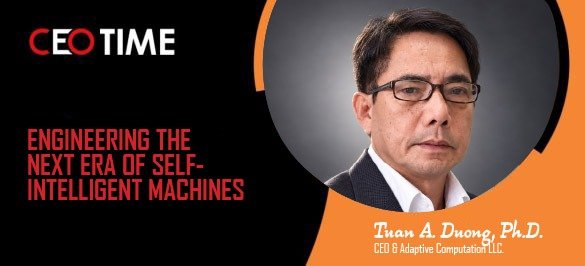
Dr. Tuan A. Duong’s Vision for Bio-Inspired Intelligence, Adaptive Computing and the Future of Autonomous Systems
Artificial intelligence is advancing at remarkable speed, yet the dominant model of AI development remains heavily dependent on large datasets, predefined architectures, substantial computing resources, and repeated training. Dr. Tuan A. Duong, Ph.D., CEO of Adaptive Computation LLC, is pursuing a fundamentally different direction, one inspired by the way biological systems perceive, learn, adapt, and respond continuously to changing environments.
His vision is rooted in decades of research across neural networks, neuromorphic engineering, machine vision, intelligent sensing, autonomous systems, and ultra-low-power computing. Before leading Adaptive Computation, Dr. Duong spent 26 years at NASA’s Jet Propulsion Laboratory (JPL), where he worked in an environment that encouraged unconventional thinking and ambitious technological exploration. Today, he is carrying that spirit into a company focused on developing what he describes as “truly intelligent machines.”
At the heart of this ambition is a philosophy that intelligence should not be static. Instead, intelligent systems should be capable of learning from their environments, incorporating new information, adapting continuously, and operating efficiently at the edge.
That philosophy has become the foundation of Adaptive Computation’s work in bio-inspired machine intelligence.
From NASA Research to an Entrepreneurial Vision
Dr. Duong’s professional journey began in the summer of 1985, when he joined JPL as an intern working on a neural computing system. His early research involved neural computers designed to simulate neuronal activity based on John Hopfield’s associative memory model and diluted coding techniques.
What followed was a 26-year journey through a broad spectrum of advanced research areas. At JPL, Dr. Duong worked on neural networks, neuromorphic hardware, sensor fusion, machine vision, electronic noses, two-dimensional differential ion mobility spectrometry, autonomous systems, ultra-low-power VLSI systems, and bio-inspired technologies.
The research environment at JPL gave him an opportunity to explore beyond conventional boundaries. His career produced 30 NASA New Technology Reports, a 2002 Exceptional NASA Space Act Award, peer-reviewed publications, and patented innovations spanning hardware neural networks, adaptive learning algorithms, cognitive computing, and AI-enabled sensing.
Rather than treating this experience as the conclusion of his technological journey, Dr. Duong transformed it into the foundation for a new entrepreneurial chapter.
Adaptive Computation emerged from this accumulated expertise with an ambitious objective: to bring biologically inspired intelligence into next-generation autonomous platforms and develop low-cost AI systems capable of productive applications across areas such as agriculture, manufacturing, and distribution.
Building Intelligence Differently
Adaptive Computation LLC is a California-based technology company originating as a Caltech spin-off. Its focus encompasses machine intelligence, perception, and cognition, with an emphasis on systems designed around biological neural building blocks and neuroscience-inspired architectures.
The company’s technology strategy centers on a Hybrid In-Memory Processing Unit, or HPU, incorporating massive parallel computation, learning, and compiler development. The broader objective is to create computing systems that can support intelligent functions while operating under practical size, weight, power, and cost constraints.
This approach reflects a central distinction in Dr. Duong’s thinking: intelligence should be able to evolve rather than remain frozen after a training cycle.
Adaptive Computation’s architecture is built around the Extended Visual Pathway, or EViP, which the company describes as a biomimetic architecture inspired by the mammalian visual pathway. The architecture combines autonomous perception, dynamic learning, and feedback mechanisms connecting short-term and long-term memory.
Its front-end uses unsupervised learning for real-time adaptive perception, while its back-end uses dynamic supervised learning intended to incorporate new information without requiring the entire learning process to restart. A neuroscience-inspired feedback mechanism connects the two, forming a foundation for what Adaptive Computation calls self-intelligence.
The objective is not simply to make machines recognize information. It is to create systems capable of continuously adapting to information as it changes.
The Extended Visual Pathway: Inspired by Biology
EViP represents one of the most distinctive elements of Adaptive Computation’s technology vision.
According to Dr. Duong, the concept emerged from studying the organization of biological visual pathways and translating those observations into computational building blocks. His mathematical and computer science background, together with algorithms including Cascade Error Projection and Spatial Independence Component Analysis, contributed to the development of the technology.
EViP is designed around multiple stages of visual processing, including features intended to support visual attention, object recognition, and recognition under low-resolution conditions. Its feedback mechanism allows information from previous experiences to influence current perception, forming a short-term memory function.
The company’s work also includes an adaptive image-search and tracking approach known as “On-line and Adaptive Image-based Search Engine in The Loop,” or OAISEE. According to the information provided by Dr. Duong, EViP demonstrated strong performance in face recognition involving large numbers of distractors and in identifying and tracking difficult objects under conditions involving noise, low resolution, unknown poses, and incomplete images. The work received a DARPA ERIS Awardable in 2025.
For Dr. Duong, the significance extends beyond a single application. EViP represents a building block for a broader intelligence architecture in which perception can remain adaptive rather than becoming fixed after initial training.
From Static Learning to Dynamic Intelligence
One of the central challenges Dr. Duong identifies in conventional supervised learning is its static nature.
Traditional approaches such as backpropagation generally rely on prepared data, predefined architectures, and labeled information established before training. Once training is completed, introducing substantially different information can require additional training or retraining.
Adaptive Computation is pursuing another model through Dynamic Supervised Learning.
The company’s approach is intended to allow new information and new labels to be incorporated on top of existing knowledge rather than requiring the entire system to start again. Dr. Duong describes this as a dynamically evolving feature-learning machine, representing a long-term memory function.
When combined with the EViP perception system and its short-term memory capability, the feedback between these components becomes an important part of Adaptive Computation’s broader self-intelligence architecture.
This concept reflects a larger principle running through Dr. Duong’s work: machines should not merely possess knowledge; they should be able to acquire and adapt knowledge during operation.
Reimagining Computing at the Edge
Adaptive intelligence also requires an appropriate hardware foundation.
For this reason, the company is developing a Hybrid In-Memory Processing Unit designed to support high-speed, low-power processing. The architecture incorporates asynchronous and hybrid in-memory processing alongside massive parallel computation and learning.
The company’s hardware roadmap includes a modified hybrid in-memory processing architecture designed to tolerate processing variations while maintaining resolution accuracy. According to the supplied profile, the approach, described as “Real-time Adaptive Tracking Systems for Irregular Target Moving Trajectory in SWaP-C Approach,” resulted in a DARPA ERIS Awardable in 2026.
The company is also pursuing a massive parallel learning mechanism intended to reduce learning time substantially compared with conventional approaches, with a stated goal of achieving at least two orders of magnitude reduction.
Alongside the hardware, Adaptive Computation is developing a compiler intended to exploit the parallel computational capabilities of its architecture across different application algorithms.
The larger objective is to combine software intelligence with hardware efficiency.
By bringing adaptive learning, bio-inspired architectures, and low-power processing together, Dr. Duong believes intelligent systems can become more practical for edge and mobile environments where conventional large-scale computing infrastructure may not always be appropriate.
Technology First, Applications with Purpose
Adaptive Computation’s development strategy has been shaped by a willingness to prioritize technological breakthroughs before commercial applications.
Dr. Duong explains that the company has historically focused on developing technology and protecting key intellectual property. Its bootstrapped funding was used to develop the necessary technologies, with applications then identified around those capabilities.
This approach has not been without challenges.
Dr. Duong acknowledges that being deeply focused on technological innovation can sometimes mean overlooking the importance of marketing strategy and commercial partnerships. Yet he views that lesson as part of the broader entrepreneurial journey.
The company has responded to difficult periods by diversifying its funding and commercialization efforts through Department of War proposals, venture capital opportunities, technology licensing, and carefully managed spending, while maintaining its principal technological direction.
This balance between technological independence and commercial engagement is becoming increasingly important as Adaptive Computation moves toward market applications.
Turning Innovation into Real-World Systems
The company is now moving from foundational technology toward products and applications.
Among its near-term initiatives are systems for face and palm recognition at the edge and cloud for IT security, as well as real-time adaptive navigation systems designed for SWaP-C-constrained environments using commercially available components.
At the same time, Adaptive Computation is working toward a more comprehensive self-learning system incorporating massive parallel learning, its HPU architecture, and compiler technology.
The ultimate goal is to make the HPU a universal massive-parallel SWaP-C engine capable of supporting different applications and computing architectures at the edge and in mobile systems.
These initiatives illustrate the company’s effort to translate years of advanced research into practical systems capable of operating outside traditional data-center environments.
A Culture Built on Vision and Persistence
For Dr. Duong, technological innovation begins with people.
His leadership philosophy centers on three principles: vision, passion, and ambition.
Vision provides direction. Passion creates the energy required to continue through difficult periods. Ambition encourages individuals and organizations to pursue objectives beyond immediate limitations.
He believes that leaders must anticipate challenges, plan carefully, remain resilient, and avoid becoming distracted by short-term benefits.
His philosophy is reflected in a simple principle: think globally rather than locally.
That mindset was shaped during his years at JPL, where he describes having the freedom to pursue imagination and unconventional ideas. The same spirit now influences the culture he seeks to establish at Adaptive Computation.
Rather than pursuing innovation simply for novelty, he wants the organization to develop technologies capable of producing meaningful long-term benefits.
The Power—and Challenge—of Staying Focused
Dr. Duong’s entrepreneurial story also demonstrates the tension between technological focus and commercial realities.
During his transition from JPL, he encountered opportunities involving investors and potential collaboration with established neural-network researchers. Some opportunities were not pursued because of his intense focus on technology development.
He does not describe these decisions with regret. Instead, he views the experience as part of a journey in which technological achievements eventually create opportunities to move into a new chapter.
Today, Adaptive Computation is pursuing partnerships, venture capital, and licensing relationships to accelerate the path from technology development to market adoption.
The company’s intellectual-property portfolio includes 17 U.S. patents and two provisional patents, including technologies associated with NASA and Caltech.
Intelligence That Works With Humanity
Perhaps the most ambitious aspect of Dr. Duong’s vision is not technological but societal.
He envisions AI that complements human life rather than simply competing with human labor.
His long-term aspiration is to develop sufficient AI and cognitive-computing capabilities that can improve productivity in areas such as agriculture, manufacturing, and distribution. Greater productivity, in his vision, could ultimately reduce the amount of time people need to devote to work and create more space for family, nature, personal well-being, and healthcare.
He describes a future in which AI “harmonically” strengthens human life rather than competing with human income.
Such a future, he argues, would also require new approaches to workforce regulation and social structures so that technological progress benefits people rather than creating additional pressure.
This perspective places Adaptive Computation’s technological work within a much broader framework.
The objective is not intelligence for intelligence’s sake. It is intelligence designed for productive application and human benefit.
Looking Ahead
Adaptive Computation stands at an important stage in its evolution.
Its foundational technologies have been developed through decades of research, its intellectual property portfolio continues to expand, and its roadmap now includes commercial products, edge intelligence, HPU development, massive parallel learning, and compiler technology.
The company’s challenge, and opportunity, is to translate its differentiated technological architecture into scalable products and partnerships while maintaining the research-driven spirit that has defined its journey.
For Dr. Tuan A. Duong, the future of AI may not depend solely on building bigger models, collecting larger datasets, or increasing computational resources.
It may also depend on building machines differently.
Machines that can perceive dynamically.
Machines that can learn continuously.
Machines that can adapt to changing information.
Machines that can operate efficiently where resources are limited.
And ultimately, machines that can contribute meaningfully to human productivity without diminishing the human experience.
From his early work on neural computing at NASA’s Jet Propulsion Laboratory to his leadership of Adaptive Computation, Dr. Duong has remained committed to exploring that possibility. His journey reflects a belief that some of the most transformative technologies emerge when researchers are willing to look beyond the prevailing paradigm and ask a different question.
Not simply how can machines compute more?
But how can machines become more adaptive, more efficient, and more naturally intelligent?
Adaptive Computation is pursuing its answer through the convergence of neuroscience, machine intelligence, adaptive learning, and advanced computing architecture.
The next chapter of that journey is already underway.