


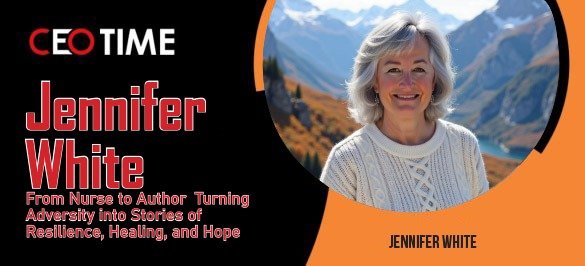
Jennifer White: From Nurse to Author Turning Adversity into Stories of Resilience, Healing, and Hope
Some of life’s most transformative chapters begin when everything familiar suddenly disappears. For Jennifer White, a retired registered nurse, author, keynote speaker, and emerging television host, that transformation began with a life-changing brain tumor surgery in January 2024. What followed was not simply a difficult period of recovery, but the beginning of an entirely new chapter, one that would lead her from nursing into writing, storytelling, advocacy, and a renewed commitment to serving others.
Before surgery, Jennifer had spent years as a registered nurse, drawing on her clinical experience to care for people during some of the most vulnerable moments of their lives. Nursing had given her a strong sense of purpose, discipline, compassion, and responsibility. Yet following her surgery, she found herself facing challenges she had never imagined for herself.
Speech became difficult. Walking had to be relearned. Memories disappeared. At one point, she did not recognize her own husband. For someone whose professional identity had been built around caring for others, suddenly becoming dependent on others was profoundly challenging.
But Jennifer chose to move forward.
During her recovery, a speech therapist encouraged her to write her thoughts on paper. That simple suggestion became the doorway to a completely unexpected future.
Writing became communication when speech was difficult. It became creative when confidence was fragile. And eventually, it became healing.
Today, Jennifer is using her experiences as a nurse and brain tumor survivor to create stories that entertain, educate, challenge perceptions, and encourage people facing their own difficult circumstances.
When One Chapter Ends, Another Begins
Jennifer’s transition into writing was not something she had planned before her surgery. In fact, becoming an author had never been part of her professional ambitions.
The turning point came during rehabilitation.
As she struggled with speech, her speech therapist suggested that she put her thoughts onto paper. Jennifer discovered that although communicating verbally was difficult, she could still express herself through writing.
That realization changed everything.
“Once I realized that I was able to write, a door opened,” she explains.
With her speech limited and her brain recovering, Jennifer began allowing herself to dream again. She describes it as “dreaming like a five-year-old” giving herself permission to imagine possibilities without being restricted by what she had previously believed was realistic.
The first ideas that emerged were children’s stories.
They were short, simple, and imaginative. More importantly, they gave Jennifer something tangible to create at a time when so much of her life had become uncertain.
The stories became an exercise for her recovering brain and a source of confidence. As her stamina improved, she moved from writing by hand to working on a computer. She began learning how to create illustrations using AI tools and experimented with turning her stories into complete children’s books.
What initially began as part of her rehabilitation gradually became a creative calling.
Then Jennifer began wondering what else she could write.
Her years as a nurse provided a wealth of experiences, while her own journey as a patient offered an entirely different perspective on healthcare. She recognized that these two worlds could come together in fiction.
To strengthen her writing skills, she enrolled in self-directed online courses that allowed her to learn at her own pace while accommodating her rehabilitation and fatigue.
Through those courses, she learned the structure and craft of fiction.
And a new career began to take shape.
From Nursing Experience to Medical Fiction
Jennifer’s nursing background became one of the most important foundations of her writing.
Her knowledge of healthcare environments, patient care, clinical processes, teamwork, and the pressures faced by medical professionals gave her stories a level of authenticity grounded in lived experience.
One setting held particular significance: the intensive care unit.
Jennifer had enjoyed working in the ICU because it required constant learning, teamwork, independent judgment, and extraordinary attention to detail. It was an environment where every moment mattered and where nurses played a critical role in monitoring patients and responding to changes.
That experience became central to her medical fiction.
Her protagonist, Abbey Roberts, is a registered nurse working in an ICU. Through Abbey, Jennifer was able to explore the professional realities of nursing while also expressing emotions drawn from her own experience.
Abbey became more than a fictional character.
In many ways, she became an extension of Jennifer herself.
When Jennifer experienced frustration, anxiety, grief, or self-doubt, she placed those emotions into Abbey. When she experienced joy, confidence, and renewed hope, those emotions found their way into the character as well.
Through writing Abbey’s story, Jennifer was also processing her own.
The result was a deeply personal form of storytelling in which professional experience and personal recovery became intertwined.
The Nurse at the Center of the Story
Jennifer’s portrayal of Abbey Roberts reflects her deep respect for the nursing profession.
Having worked in clinical environments herself, she understands the complexity of the nurse’s role. In intensive care, nurses are often the professionals who remain continuously at the patient’s bedside, observing changes minute by minute.
Doctors may come and go to assess patients, order tests, and make clinical decisions, but nurses are continuously monitoring what is happening.
They recognize subtle changes.
They communicate concerns.
They coordinate care.
They advocate for patients.
And they frequently act as the vital connection between the medical team and the person receiving care.
Jennifer wanted her fiction to highlight that reality.
Through Abbey, she hopes readers gain a deeper appreciation for the dedication, intelligence, sensitivity, and responsibility carried by nurses every day.
Her stories are informed by experiences accumulated across different nursing environments, allowing her to portray healthcare as complex, stressful, demanding, and deeply human.
That lived experience also gives her characters emotional depth.
The situations may be fictional, but the emotions behind them are often authentic.
A Health Journey That Changed Everything
Jennifer’s own recovery remains at the heart of her transformation.
After brain tumor surgery, she faced a reality that was completely different from the life she had known.
She could no longer speak normally. She struggled to walk. Her memories were affected. She experienced the devastating realization that she did not recognize her husband.
The experience forced her to reconsider what she had previously taken for granted.
Walking, for example, had always been an ordinary part of life. Suddenly, it became a major achievement.
Jennifer had to relearn how to walk and initially relied on a walker. Balance was a significant challenge, and she had to be careful to avoid falling.
When she returned home, she continued practicing. During the winter, bundled up against the cold, she walked around her wraparound porch as part of her recovery.
Slowly, progress came.
Today, she has regained her ability to walk, balance, and drive.
The speech took longer.
But the process taught her something profound about patience, persistence, and the human capacity to adapt.
Jennifer understood that she had been given an opportunity to begin again.
At 62, she found herself asking a question that might sound unusual at that stage of life: What would I love to be when I grow up?
The question opened a new world of possibilities.
Writing as a New Voice
For Jennifer, writing became much more than a professional pursuit.
It became a voice.
At a time when speech had been taken from her, writing gave her another way to communicate her thoughts, emotions, imagination, and experiences.
“Writing saved me,” she says.
That statement captures the transformative role writing has played in her recovery.
Before surgery, Jennifer had no intention of becoming an author. After surgery, writing became one of the most important parts of her reinvention.
It also allowed her to continue doing something that had always been central to her identity: serving others.
As a nurse, she had helped people through difficult medical circumstances. As an author and speaker, she now sees an opportunity to help people in a different way.
Her stories can entertain readers while also raising questions about healthcare, resilience, identity, recovery, and the challenges people face within healthcare systems.
She wants readers to enjoy the suspense, but she also wants them to pause and ask whether the situations presented in her novels could happen in real life.
If they can, she believes those stories can become starting points for meaningful conversations.
And conversations can lead to advocacy and change.
Creating Abbey Roberts
The creation of Abbey Roberts was also deeply connected to Jennifer’s own struggle with identity.
After her surgery, Jennifer felt as though part of her identity had been taken away. Her brain had changed without her consent, and she was trying to understand who she was beyond being a survivor.
Abbey provided a way to explore that question.
Jennifer wanted Abbey to be active, conscientious, intelligent, and deeply committed to her patients. She wanted the character to reflect the passion she had seen in nurses throughout her career.
At the same time, Abbey carries Jennifer’s emotional journey.
The character’s experiences with self-doubt, anxiety, frustration, and uncertainty reflect Jennifer’s own experiences after surgery.
Even Abbey’s marriage became a reflection of Jennifer’s personal journey. By giving Abbey a husband named Kevin, Jennifer explored themes of partnership, identity, change, and rebuilding that had become deeply meaningful in her own life.
In this way, fiction became a bridge between who Jennifer had been and who she was becoming.
Balancing Accuracy with Suspense
Writing medical fiction presents a unique challenge: creating stories that are entertaining while remaining believable.
For Jennifer, her nursing background provided a strong foundation.
She understood medical terminology, hospital environments, equipment, procedures, and the dynamics of clinical teams. At the same time, she recognized that readers are increasingly familiar with medical environments through popular television programs and other forms of entertainment.
The challenge was learning how to incorporate her knowledge effectively into fiction.
Her writing courses helped her understand how to transform technical knowledge into engaging storytelling.
The result is an approach that combines medical authenticity with suspense and character-driven narratives.
Rather than overwhelming readers with technical details, Jennifer uses her experience to make the environment feel credible while keeping the story moving.
Stories for Children, Too
Jennifer’s creativity extends beyond medical thrillers.
Her early writing journey led her to create children’s stories featuring characters such as Molson and Jenny.
These stories were born during the earliest stages of her reinvention, when she was still rebuilding confidence and exercising her recovering mind.
Their simplicity became part of their appeal.
Jennifer envisioned the books as stories that could inspire children’s imaginations, encourage early reading, and provide meaningful opportunities for children and caregivers to connect through bedtime reading.
When traditional publishing did not provide the opportunity she was seeking because of the use of AI-assisted illustrations, Jennifer chose another path: self-publishing.
That decision allowed her to maintain control over her work while bringing the stories directly to local communities.
She has been able to sell the books at local fairs and explore sponsorship opportunities that allow the books to reach daycares and schools.
For Jennifer, this is another form of service.
Choosing Independence as an Author
Building an independent writing career has not been without challenges.
Jennifer quickly recognized that becoming a traditionally published author could involve navigating a complicated system of agents, publishers, submissions, word limits, pitches, and timing.
Rather than spending years trying to fit into a system she felt restricted by, she chose self-publishing.
The decision came with financial and professional challenges, but it also gave her something she valued deeply: control.
She could determine what stories to tell, how to tell them, and when to bring them to readers.
At the same time, she understood that she needed to continue learning.
Jennifer openly acknowledges the limitations created by her brain injury and recovery. Rather than allowing those limitations to define her future, she chose to work within them.
Learning the craft of writing became part of her rehabilitation.
The mental effort required to structure stories, create characters, and develop narratives challenged her brain in new ways.
For Jennifer, writing was therefore both creative work and another form of rebuilding.
A Broader Mission of Advocacy
Jennifer’s ambitions extend beyond books.
She has chosen to become a keynote speaker, sharing her story with audiences and using her experience to encourage people facing difficult circumstances.
Her message is rooted in resilience.
She believes adversity can be overcome, even when the path forward is unclear.
Her own recovery taught her the importance of asking for help, researching possibilities, remaining patient, and continuing to move forward.
She also draws inspiration from the concept of neuroplasticity, the brain’s ability to adapt and reorganize.
As a nurse, she understood the science behind the brain’s capacity to change. As a patient, she experienced the process personally.
That combination of professional knowledge and lived experience now shapes her advocacy.
She wants people to understand that a difficult diagnosis or life-changing event does not necessarily mean the end of the story.
Sometimes it can become the beginning of an entirely different one.
Expanding the Story Beyond Books
Jennifer’s future plans reflect the breadth of her new identity.
In addition to writing and keynote speaking, she is exploring podcasting and preparing for an upcoming television project from Hollywood called Inside the Story Confidential.
The concept is closely aligned with her broader mission: finding and sharing extraordinary human stories about people whose lives have been changed by significant experiences.
Her goal is not simply to tell stories for entertainment.
She wants to inspire.
She wants to encourage.
She wants to help people heal.
Jennifer also participates in women’s online communities where members support one another in their professional and creative endeavors. These communities have become valuable spaces for learning, networking, and sharing her work.
Her keynote speaking career is also developing, with professional training helping her strengthen her ability to create speeches that are engaging, meaningful, and useful to audiences.
Together, these platforms offer Jennifer opportunities to reach people far beyond the pages of her books.
A Second Opportunity to Serve
At the heart of Jennifer White’s journey is one simple idea: service.
She has spent much of her life serving others as a nurse. Today, she sees her role differently, but the underlying purpose remains.
She wants her children’s books to inspire young readers.
She wants her medical thrillers to entertain while encouraging conversations about healthcare.
She wants her personal story to provide hope to people facing difficult circumstances.
She wants her speaking engagements to demonstrate that reinvention is possible.
And through television and other platforms, she hopes to introduce audiences to people whose experiences can teach, inspire, and encourage others.
Jennifer describes herself as a retired nurse turned writer, speaker, and soon-to-be television host. Yet retirement, in her case, has not meant stepping away from purpose.
It has meant redefining it.
A Legacy of Hope, Courage, and Service
Jennifer does not measure her legacy solely by the number of books she writes or platforms she reaches.
Her ambition is much more personal.
She hopes to inspire children through storytelling, help people heal through the lessons of her own journey, entertain readers through medical fiction, and encourage difficult but necessary conversations about healthcare.
She wants people to recognize that change is possible.
Her journey demonstrates that life can take an unexpected turn without bringing purpose to an end.
A brain tumor surgery changed Jennifer’s abilities, identity, and direction. But it also revealed possibilities she had never considered.
When speech became difficult, she found writing.
When walking became impossible, she learned to walk again.
When her professional identity was disrupted, she created a new one.
When the future became uncertain, she allowed herself to dream.
And when she discovered a new voice, she decided to use it in service of others.
That may ultimately be Jennifer White’s most powerful story, not simply that she became an author after surviving a life-changing medical experience, but that she refused to allow the experience to define the limits of her future.
Her story is still being written.
And the next chapter promises to be just as meaningful as the ones that came before.