


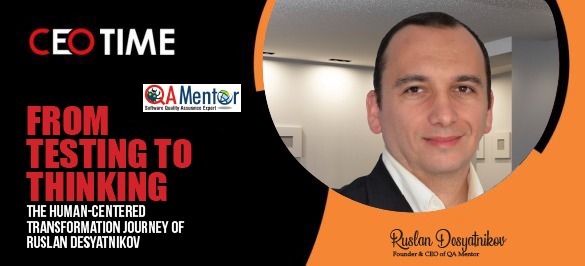
From Testing to Thinking: The Human-Centered Transformation Journey of Ruslan Desyatnikov
In an era defined by rapid technological disruption, where artificial intelligence, automation, and cloud computing dominate boardroom conversations, one leader is quietly reshaping how the world thinks about quality, transformation, and innovation. For Ruslan Desyatnikov, success is not measured by how fast systems are built, but by how thoughtfully they are designed, tested, and trusted.
As the Founder and CEO of QA Mentor, Ruslan has spent decades challenging one of the most overlooked assumptions in technology that quality assurance is merely a final checkpoint. Instead, he has championed a powerful idea: quality is a mindset, and testing is not execution it is thinking.
This belief has not only defined his career but has also positioned him as a leading voice in the evolution of digital transformation in the age of AI.
From Curiosity to Conviction
Ruslan’s journey into software testing did not begin with a grand vision. It started with curiosity and a desire to understand how systems function and why they fail.
After completing his degree in Computer Information Systems from Baruch College and earning an MBA in Technology Management, he entered the workforce at a time when QA was often undervalued. Testing was typically treated as a routine, end-stage activity, something to validate finished products rather than shape them.
However, his early work with complex enterprise systems, particularly in high-risk industries like finance, changed everything.
In these environments, failure was not an option. A single defect could result in financial loss, reputational damage, or operational breakdown. It was here that Ruslan began to see testing differently not as a checklist, but as an investigation.
He noticed a critical gap: teams were executing test cases without fully understanding business impact. Failures were rarely due to lack of effort; they were due to lack of thinking.
This realization became the foundation of his philosophy and ultimately shaped the trajectory of his career.
Building QA Mentor: A Vision Takes Shape
As Ruslan moved into leadership roles, managing global QA teams and working with Fortune 500 companies, he saw a recurring pattern of organizations investing heavily in development but underestimating the importance of quality.
Determined to change this narrative, he founded QA Mentor with a clear mission: to transform QA from a cost center into a strategic function.
Under his leadership, the company has grown into a global provider of comprehensive QA services, including functional testing, automation, performance testing, security testing, accessibility testing, and AI testing.
But what truly differentiates QA Mentor is its structured approach. The company has developed its own methodologies, frameworks, and metrics systems, ensuring consistency, precision, and measurable outcomes.
Equally important is its commitment to education. Through training programs and courses, QA Mentor has helped thousands of professionals build careers in testing, reinforcing its role not just as a service provider, but as an industry enabler.
Redefining Digital Transformation
In 2026, digital transformation has evolved far beyond its original meaning. It is no longer about simply adopting new tools or migrating to the cloud.
For Ruslan, digital transformation is about becoming “intelligently connected” in an ecosystem where every decision, process, and interaction is enhanced by AI and data, but guided by human judgment.
This marks a shift from implementation to intention.
Organizations must now ask deeper questions: Why are we building this? Who does it serve? How does it create value?
According to Ruslan, true transformation is cultural. It requires aligning technology with business goals and user experience, ensuring that innovation translates into meaningful outcomes.
Automation, in this context, is not about speed alone it is about intelligence and purpose.
Human Intelligence in an AI-Driven World
As artificial intelligence continues to reshape industries, many organizations are rushing to adopt it. Ruslan, however, approaches AI with a critical perspective.
He recognizes its power but also its limitations.
This understanding led to the creation of Human Intelligence Software Testing (HIST), a methodology that places human judgment at the center of testing while leveraging AI as a supportive tool.
HIST represents a fundamental shift. It moves away from blind automation and emphasizes critical thinking, risk analysis, and investigative testing.
At QA Mentor, this philosophy has also given rise to a new role: AI validators.
These professionals are trained not just to use AI tools, but to challenge them to identify inaccuracies, detect biases, and ensure ethical alignment.
Because in a world driven by algorithms, trust cannot be automated. It must be built.
Innovation Rooted in People
While many organizations equate innovation with technology, Ruslan sees it differently.
At QA Mentor, innovation is driven by people.
The company fosters a culture where questioning assumptions is encouraged, and every process must justify its purpose. Employees are given ownership of their work, empowering them to think creatively and take responsibility for outcomes.
Training plays a critical role, but the focus is not just on tools. Instead, the emphasis is on developing analytical thinking, risk assessment, and problem-solving skills capabilities that remain relevant regardless of technological change.
Psychological safety is another cornerstone. Team members are encouraged to challenge ideas, including those of leadership, creating an environment where innovation can thrive.
Leading Through Change and Uncertainty
Digital transformation is rarely linear. It involves uncertainty, disruption, and constant change.
For Ruslan, leadership in such an environment requires more than technical expertise; it requires emotional intelligence.
One of the most important lessons he has learned is that during times of uncertainty, teams need reassurance more than direction. They need clarity, trust, and a sense of purpose.
By fostering open communication and creating a safe space for experimentation, he enables his teams to adapt with confidence.
Because ultimately, transformation is not just about systems it is about people.
Balancing Automation and Creativity
The rise of automation has sparked concerns about job displacement.
He sees automation as an opportunity not a threat.
By eliminating repetitive tasks, automation frees individuals to focus on what truly matters: creativity, innovation, and human connection.
However, achieving this balance requires intentional effort. Organizations must invest in upskilling their workforce, ensuring that employees can not only use AI tools but also evaluate and guide them.
This combination of machine efficiency and human creativity is what defines a resilient organization, one that can thrive in the face of disruption.
Delivering Impact Through Quality
One of the most powerful demonstrations of Ruslan’s approach can be seen in a recent project involving a global insurance platform.
The organization was struggling with high defect rates, poor customer satisfaction, and . The initial solution was to increase automation.
Instead, QA Mentor introduced HIST.
By focusing on investigative testing, risk-based prioritization, and business alignment supported by AI tools the company transformed its QA processes.
The results were striking: a 32% reduction in post-release defects, faster release cycles, and improved trust across stakeholders.
This case underscores a key principle: transformation is not about adding tools it is about improving experiences.
Overcoming Barriers to Transformation
Despite advancements in technology, many organizations still struggle with digital transformation.
According to Ruslan, the biggest barrier is not technology, it is mindset.
Fear of change, lack of alignment, and insufficient investment in people often prevent organizations from realizing the full potential of innovation.
The solution lies in shifting focus.
Leaders must prioritize communication, build trust, and create a culture that supports experimentation. They must embed quality into every stage of development, ensuring that it is not an afterthought, but a foundation.
Ethics, Inclusion, and Responsibility
As technology becomes more powerful, the responsibility that comes with it grows.
Ruslan emphasizes that ethics, inclusivity, and sustainability must be built into digital systems from the start.
This includes ensuring human oversight in AI-driven processes, promoting diversity within teams, and prioritizing accessibility in product design.
It also means optimizing processes to reduce waste and maximize value, contributing to a more sustainable approach to innovation.
Because true progress is not just about what we build but how we build it.
Bridging the Digital Divide
Beyond business success, Ruslan sees a broader responsibility for technology leaders: bridging the digital divide.
This involves creating opportunities for underserved communities through education, remote work, and mentorship.
It also requires designing technology that is accessible and inclusive, taking into account real-world constraints such as connectivity and digital literacy.
By doing so, organizations can create systems that serve not just a select few, but society as a whole.
A Vision for the Future
Looking ahead to 2035, Ruslan envisions a world where technology enhances human potential rather than replacing it.
In this future, QA is not an afterthought, it is a strategic pillar of innovation. Testing is defined by thinking, and quality is embedded into every stage of development.
Professionals in QA are recognized as critical contributors, thinkers, problem-solvers, and guardians of digital trust.
At the heart of this vision is a simple idea: technology should serve people.
Lessons for the Next Generation
For aspiring leaders, Ruslan’s advice is both practical and profound.
Focus on people, not just technology. Build systems that create value, foster trust, and improve experiences.
Embrace innovation, but stay grounded in purpose. Avoid chasing trends instead, focus on impact.
Surround yourself with diverse perspectives, and create environments where individuals can thrive.
Above all, lead with empathy, curiosity, and integrity.
A Legacy of Transformation
The journey of Ruslan Desyatnikov is more than a success story; it is a blueprint for the future of digital transformation.
By redefining the role of QA and placing human intelligence at the center of innovation, he has challenged an entire industry to think differently.
In a world where speed often overshadows substance, his work serves as a reminder that true progress lies in balance.
Because in the end, transformation is not just about technology.
It is about people, purpose, and the pursuit of quality in everything we build.