


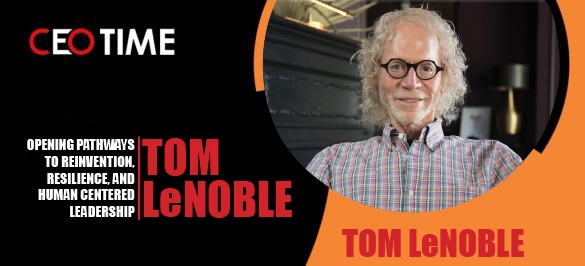
TOM LeNOBLE: OPENING PATHWAYS TO REINVENTION, RESILIENCE, AND HUMAN CENTERED LEADERSHIP
The Question That Changed Everything
What happens when success no longer feels aligned with who we truly are?
It is the kind of question most high achievers push quietly to the back of their minds, the sort of reckoning that arrives not during failure, but at the very peak of everything they worked to build. For Tom LeNoble, that question became impossible to ignore. And rather than suppress it, he chose to follow it all the way into a new life, a new purpose, and a new way of leading.
For decades, LeNoble operated at the center of corporate America’s most influential environments. His career spans Fortune 500 giants including MCI, Walmart.com, Palm, and Facebook, as well as multiple high-growth startups. These were organizations that helped define the architecture of modern commerce, communication, and digital culture. He earned a reputation not only for operational excellence but for an uncommon ability to see what others overlooked: the human being behind the title.
Yet the most compelling chapter of Tom LeNoble’s story is not what he built during those years. It is what he chose to build afterward.
Today, LeNoble is recognized internationally as a confidential advisor, leadership coach, speaker, author, podcast host, and philanthropist. Through Opening Pathways Collective, he has created a platform that brings together advisory, media, publishing, and daily practice into one place, an ecosystem dedicated to helping individuals navigate reinvention with greater clarity, honesty, and intention. His reach extends to founders, executives, nonprofit leaders, healthcare professionals, creatives, and entrepreneurs: anyone seeking something increasingly rare in modern professional culture authenticity.
At the core of everything he does sits a belief that sounds almost too simple until you sit with it long enough: better conversations create better thinking, and better thinking changes lives.
Leadership Beyond Performance
Modern leadership culture is saturated with frameworks, productivity metrics, optimization playbooks, personal branding strategies. These conversations have their place, but Tom LeNoble has staked his work on something the frameworks consistently miss.
Rather than teaching people how to perform leadership, he focuses on helping them reconnect with themselves beneath the performance. That single distinction has become the cornerstone of his reputation, and the reason leaders seek him out at moments when every conventional solution has already been tried and found wanting.
His advisory work is built around moments of transition periods when individuals find themselves questioning identity, purpose, direction, or fulfilment despite outward success. These moments may emerge during career shifts, organizational growth, personal loss, health crises, burnout, or profound reinvention. What makes this perspective credible and deeply personal is that it was forged not in a classroom, but through decades inside some of the world’s highest-pressure corporate environments, and through private battles that fundamentally altered LeNoble’s understanding of what it means to be alive. His work lives at the intersection of leadership psychology, emotional resilience, and human transformation, a space rarely occupied by traditional consultants, and almost never by those who have lived through it themselves.
From Silicon Valley to Human Transformation
To understand where Tom LeNoble is going, it helps to understand where he has been. His professional arc traces the explosive evolution of the technology industry across several decades from the early days of digital communication at MCI to the world-altering scale of Facebook and the retail disruption of Walmart.com. He witnessed innovation up close, at velocity, inside organizations rewriting the rules of entire industries.
But amid the growth, the milestones, and the momentum, another reality was coming into focus, one rarely discussed openly in executive circles. Behind the titles and the strategic objectives, LeNoble observed people struggling silently. Identity. Exhaustion. Fear. Loneliness. Disconnection. Success, he realized, often arrived with hidden complexity attached. Many of the most visibly accomplished individuals he worked alongside had mastered external achievement while quietly losing connection with themselves.
Over time, Tom became known for something beyond operational leadership or executive strategy. He became known for his ability to guide difficult conversations with unusual depth and candor the willingness to go where most advisors simply would not. That quiet capability eventually evolved into the foundation of Opening Pathways Collective.
The organization is intentionally broader than a traditional consulting or coaching firm. It functions as a multidimensional platform encompassing executive advising, speaking engagements, leadership development, podcast conversations, written reflections, philanthropic initiatives, and transformational dialogue. More importantly, it reflects a mission that can be stated simply: creating space for people to think clearly again.
The Memoir That Changed the Conversation
LeNoble’s emergence as a widely recognized leadership voice accelerated dramatically with the release of his award-winning memoir, a book whose title alone announces that this will be no conventional story of professional triumph.
My Life in Business Suits, Hospital Gowns, and High Heels captures the full arc of an extraordinary life: rising from a childhood home known as “the Shack,” with no hot water, to the heights of Silicon Valley, helping build some of the world’s most influential companies, surviving two life-threatening illnesses, and navigating the heartbreak of the AIDS epidemic alongside personal loss and the high-stakes pressures of corporate leadership.
Each element of the title carries deliberate weight. The Business Suits represent his years inside Fortune 500 boardrooms and Silicon Valley startups. The Hospital Gowns reflect multiple life-threatening diagnoses and prolonged medical battles including being told three times that he had six months to live. And the High Heels speak to something deeper: personal identity, transformation, visibility, and the profound courage it takes to live authentically in a world that rarely makes space for complexity.
What set the memoir apart from the crowded shelf of leadership books was its absolute refusal to present resilience as a polished, inspirational commodity. LeNoble approached resilience as lived reality messy, emotional, imperfect, and searingly human. He explored identity, illness, reinvention, vulnerability, leadership pressure, and healing with an openness that made many readers feel, for the first time, genuinely seen.
The memoir ultimately became more than a personal story. It became an invitation for readers to reconsider what strength truly means in a world that too often rewards image over authenticity and productivity over emotional well-being.
The book received significant recognition with five book awards, including being named a 2026 Independent Press Award Distinguished Favorite in the category of Inspiration a competition judged by experts from across the book industry, including publishers, writers, editors, designers, booksellers, librarians, and professional copywriters, with winners selected based on overall excellence. It established LeNoble as a distinctive and necessary voice in the broader landscape of leadership and personal development and perhaps more importantly, it created a sense of recognition for readers who had long felt unseen within traditional professional culture.
Morning Ground and the Return to Presence
Where the memoir arrived with full force, LeNoble’s next book chooses to whisper and that restraint may be its greatest strength.
Morning Ground grew from a daily reflective series launched across Instagram and Facebook, offering brief reflections designed to help individuals establish clarity before the demands of the day begin. Scheduled for release in June 2026, the book’s premise is deceptively, almost stubbornly simple: before the noise of the day begins, pause. Coffee. Reflection. Presence.
In a culture engineered for urgency and perpetual stimulation, the concept resonates precisely because of its restraint. Rather than prescribing optimization or fueling the mythology of relentless productivity, Morning Ground invites readers to inhabit their lives more consciously. It explores emotional grounding, leadership awareness, resilience, and intentional living not through grand gestures, but through the quiet discipline of showing up for ordinary moments before the world claims them.
The book’s growing following reflects a broader cultural reckoning underway across professional and personal spaces. Resilience, LeNoble argues, is not solely the capacity to survive crises. It is equally the practice of remaining present during the ordinary moments that accumulate, quietly and unnoticed, into a life. In a world where many individuals feel emotionally overstimulated yet spiritually disconnected, that reminder lands with unexpected force.
The Philanthropic Mindset
One of the most compelling and original ideas in LeNoble’s body of work is a concept he calls The Philanthropic Mindset, it begins by dismantling a comfortable assumption.
Philanthropy, in its conventional definition, belongs to those with surplus wealth. LeNoble expands the definition until it becomes something else entirely: a way of moving through the world. For him, generosity is not measured in dollars. It is measured in attention. Conversation. Compassion. Presence. A moment of genuine kindness offered without expectation of return.
This philosophy reframes generosity as something accessible to every person regardless of status, income, or influence. A conversation becomes an act of generosity. Attention becomes a form of leadership. And in an era of widespread emotional exhaustion and social disconnection, intentional presence itself becomes perhaps the rarest and most valuable gift one person can offer another.
The concept has resonated powerfully within nonprofit organizations, healthcare communities, leadership conferences, and corporate environments searching for more human-centered approaches to culture and communication. It also reflects, more than anything else, the deeper identity of Opening Pathways Collective: an organization not primarily focused on helping individuals achieve external success, but on helping them reconnect with what matters most.
Living Fully While Dying
Among LeNoble’s most impactful keynote experiences is a presentation that defies easy categorization. Living Fully While Dying explores mortality, resilience, meaning, identity, and the urgency of intentional living through the lens of his own medical experiences and it does so without a single cliché.
This is not conventional motivational speaking. LeNoble does not use hardship as inspirational furniture. Instead, he addresses the genuine emotional complexity of navigating profound uncertainty while continuing to lead, create, love, and show up fully in life. He asks audiences a question that cuts straight through the professional noise: what would actually change in your life if you truly understood that time is limited?
Rather than framing mortality through fear, LeNoble presents it as an invitation to stop postponing joy, to stop delaying the difficult conversations, to stop waiting for permission to become who we already know ourselves to be.
Audiences consistently describe the experience as grounding, emotional, and transformative not because it is dramatic, but because it speaks to something universally human: the desire to live more intentionally before circumstances force the realization upon us. The keynote has crossed audiences in healthcare systems, LGBTQ+ communities, nonprofit organizations, and major corporate conferences precisely because its message transcends industry, identity, and role. At its heart, Living Fully While Dying is not about death at all. It is about awakening.
A Different Kind of Leadership Voice
One of the reasons LeNoble’s work continues gaining traction internationally is the precise cultural moment it has arrived in. Performative leadership culture, all visibility, velocity, and curated certainty is exhausting its audience. Beneath the expectations of the modern professional world, many high-achieving individuals are quietly managing burnout, identity conflict, emotional fatigue, and a persistent sense of disconnection they cannot name in a meeting.
LeNoble addresses those realities directly. His communication style is reflective rather than performative. Thoughtful rather than transactional. Human rather than heavily branded. He builds trust not by having the most impressive answer, but by asking the most honest question.
Rather than encouraging people to become entirely new versions of themselves, his philosophy centers on remembering who they are beneath external noise and expectation and aligning how they lead with who they actually are. This represents a significant departure from the dominant self-improvement narrative, which too often equates reinvention with relentless productivity and image construction.
In contrast to many leadership platforms that emphasize motivation and external performance, Opening Pathways Collective is centered on recalibration. Motivation can be temporary. Clarity endures. It is precisely the balance between professional credibility and emotional honesty that continues to distinguish LeNoble, and his work, in a saturated landscape.
Building Space for What Comes Next
As Opening Pathways Collective continues its expansion through books, speaking engagements, executive advisory services, leadership development, and a podcast that recently surpassed its 100th episode milestone the initiative reflects a broader effort to build a cohesive platform around a single idea: that leadership challenges are often inseparable from the person experiencing them.
Tom LeNoble is not building a personal brand. He is building space. Space for reflection in environments dominated by urgency. Space for authenticity in cultures shaped by performance. Space for meaningful dialogue in a world saturated with noise.
People are no longer searching for information alone. They are searching for connection, clarity, and conversations that feel real. LeNoble’s life’s work speaks directly to that need not from a position of removed authority, but from a place of lived experience, hard-won wisdom, and the quiet conviction that transformation begins the moment a person becomes willing to engage honestly with themselves.
In a professional landscape defined by acceleration, optimization, and surface level visibility, that reminder carries unusual and necessary weight. Because leadership, at its most essential, is not only about building companies or careers or influence. It is about learning to remain fully human while doing so.
And perhaps that is the most important pathway Tom LeNoble continues to open for others not a pathway toward achievement alone, but a pathway back to presence, meaning, and a life lived with full intention.